
Digital access to the Danish poet Hans Christian Andersen (1805-75)
April 30, 2026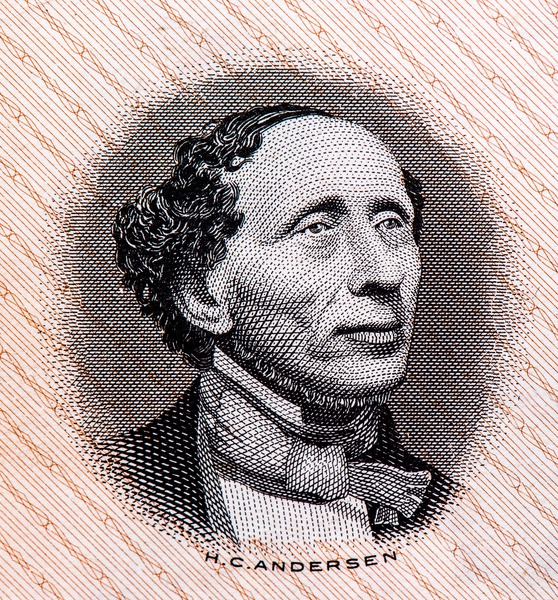
The Digital Hans Christian Anderesen – the tools
Today it is easier to study Hans Christian Andersen because of the quick digitalisation also in humanities. New services, new texts, new studies come so quickly that is why it is difficult to be updated. I will try to update you here in this presentation. Many books are mentioned without internet access today. I have added them while they tomorrow could be on internet or if they are useful also for researchers with a minimum of knowledge of the Dansh language.
Year by year more related to Hans Christian Andersen can be found through internet. This gives new options and new insights.
A quick overview of the options:
1. To access Hans Christian Andersen’s works
2. Hans Christian Andersen’s Dagbøger (Diaries) (1825-75) & Almanakker (Almanacs) (1833-73)
3. Hans Christian Andersen’s letters and letters to Hans Christian Andersen
4. Bibliographies
5. Best Biographies
6. Anderseniana
7. Dictionary to support understanding and translation
8. Bible translations in Hans Christian Andersen’s time
9. Newspapers and other Periodicals
10. Books in Portuguese
11. Hans Christian Andersen paper cuttings, picture books and photos of him
12. Hans Christian Andersen Manuscripts
To access Hans Christian Andersen’s works
Hans Christian Andersen works publish in Denmark you can find in the national bibliography. In Denmark called Dansk Bogfortegnelse. It starts in 1841. More information here: https://lex.dk/Dansk_bogfortegnelse
Collected Works.
First time we have Hans Christian Andersen’s collected works in Danish is: Samlede Skrifter, Vol. I-XXXIII, C. A. Reitzel, Kjøbenhavn 1853-79,
Index is here: https://andersen.sdu.dk/vaerk/register/ss.html (April 2nd, 2026)
Online is here: https://www.kb.dk/e-mat/dod/115208016215-bw.pdf - this is one Vol. You can acces others also at kb.dk, The Royal Library in Copenhagen.
Samlede Skrifter. Anden Udgave, Vol. 1-15, C. A. Reitzels Forlag, Kjøbenhavn 1876-80,
Index is here: https://andersen.sdu.dk/vaerk/register/info.html?vid=1036 (April 2nd, 2026)
This edition is the most used.
Samlede værker Vol. 1-18, Det danske Sprog- og Litteraturselskab og Gyldendal, København 2003-06. This edition is with Hans Christians Andersen’s Papercuts and other illustrations.
You can buy it for a low price now. This collected works are very much complete and with a lot of important illustrations and comments.
Index is here: https://dsl.dk/publication?id=114 (March 31st, 2026)
At hcandersen.dk you can find most of the Samlede værker Vol. 1-18. But only the text of Hans Christiab Andersen. Not the illustrations. Not the introductions. The introductions were later after a revision given out in: Klaus P. Mortensen: Tilfældets poesi. H.C. Andersens forfatterskab, Gyldendal, 2007. hcandersen.dk is a very usefull hompage. A small part of it has English translation.
Do not use Andersens Værker Vol. 1-12, Med Illustrationer af V. Pedersen, Forlaget Danmark, 1935-36. This collection is very poor.
In German language you have first collected works in 50 Vol. called: Gesammelte Werke from 1847-72.
Autobiographies
Three autobiographies are especially important. All of them in more editions. First print of the autobiographies is:
H. C. Andersens Levnedsbog. Digterens Liv 1805-31. Aschehoug & Co., København 1926. (Hans Christian Andresen wrote this in 1832. The manuscript found later).
Mit eget Eventyr uden Digtning, Nyt Nordisk Forlag, København 1942. (First given out in Germany as Das Märchen meines Lebens ohne Dichtung, Vol. I-II in Hans Christian Andersens collected works (Gesammelte Werke Vol. I-II) which began to appear in 1847 in Leipzig.)
The most known is Mit Livs Eventyr, Vol. I-II, C. A. Reitzels Forlag, Kjøbenhavn 1855 and 1877. This work is accessible in multiple English translations.
Poems
Poems are the most difficult to translate. There are only a few good translations.
Dramas and opera
Dramas and opera texts are not very known outside Denmark. There are limited translations available.
Novels
Hans Christian Andersens six novels were important in the first part of his life. Improvisatoren (English: The Improvisatore, or life in Italy) is the most translated. In Portuguese you find the novel Kun en Spillemand tanslated (Apenas um Rabequista, Casa Editora Vecchi Ltda., Rio de Janeiro, 1955.) This novel is known for the book Søren Kierkegaard wrote about it.
Stories and Fairy Tales
The best Danish edition printed is: H. C. Andersens Eventyr, Vol. I-VII, Hans Reitzels Forlag og C. A. Reitzels Forlag, København 1963-90. Published by Det danske Sprog- og Litteraturselskab. Vol. VII has especially useful comments. It was very much delayed. Only a few times Hans Christian Andersen’s manuscripts have been used by Erik Dal, Erling Nielsen, og Flemming Hovmann. It is a significant deficiency, as the manuscripts provide a lot of new information. But it is the best and the edition researchers use to use.
If you need to use translations in English, I can recommend the new English translation. It is online since 2022: Hans Christian Andersen's Fairy Tales and Stories. Translated by John Irons in collaboration with Jacob Bøggild and Mads Sohl Jessen. Published by The Hans Christian Andersen Center at the University of Southern Denmark.
Link: https://hcams.andersen.sdu.dk/exist/apps/andersen-irons/index.html (April 2nd, 2026)[1]
The Portuguese translations you know very well, one can look after it later.
Travel Books
Hans Christian Andersen’s seven travel books are known in translations. You have also the book about his travel to Portugal in 1866 in more Portuguese translations. See later.
It is truly clear that the countries Andersen write about in a travel book are more often translated to the language in the same country.
Pictures – paper cuts and picture books
There is a growing attention on Hans Christian Andersen’s papercuts and picture books. Some of them are translated. Astrids Stampes Billedbog, Odense Bys Museer, Gyldendal, København, 2003, pp. 413 ill., is translated to English: Astrid’s Stampes Picture Book, Gyldendal, Gylling, 2003. 414 pp. ill.
A Brazilian artist has used the papercuts. This is G. d. SOUZA: Do Alto de Meu Chapéu. Ilustrações de Hans Christian Andersen, 1ª. edição, 1ª. impressão, Porto Alegre, Projeto Editora, 2011, 56 pp. ill.
Hans Christian Andersen’s Dagbøger (Diaries) (1825-75) & Almanakker (Almanacs) (1833-73)
Key information about Hans Christian Andersens work and life you find in the diaries and the Almanacs. In print: H. C. Andersens Dagbøger 1825-1875 I-XII. Udgivet af Det Danske Sprog- og Litteraturselskab og G. E. C. Gads Forlag, København,1971-77. (Paperback 1995-96) and H. C. Andersens Almanakker 1833-1873. Udgivet af Det Danske Sprog- og Litteraturselskab, København, 1990.
In digital vol I-X at The Royal Liberary: https://epub3.kb.dk/hcadag/epub3/EPUB/ (April 2nd, 2026). It is important to know the vol. XI-XII with excellent all kinds of index. This is – sad enough - not part of the digital version.
There is a long tradition to make high quality index in Hans Christian Andersen studies.
In print: H. C. Andersens Almanakker 1833-1873. Det danske Sprog- og Litteraturselskab og G. E. C. Gads Forlag, København 1990 (Paperback 1996).
The almanacs from 1833-1873 you can find at The Royal Library in a new digital version: https://permalink.kb.dk/permalink/2006/manus/240/dan/ (April 2nd, 2026). Here index is included.)
Parts of the diaries and almanacs can be found on many sites of the internet.
Hans Christian Andersen’s letters and letters to Hans Christian Andersen
The letter database contains all known letters to, from and about Hans Christian Andersen, which are in private and public ownership. The largest letter collections are at The Royal Library in Copenhagen and in Hans Christian Andersen's House in Odense. Now called: Museum Odense.
The letter database is the result of a collaboration between the H.C. Andersen Centret/SDU and H.C. Andersen's House (Now: Museum Odense). Both are in Odense.
There are 1284 Recipients and 1263 senders included. 1921 persons together. 13.586 letters or messages you can find here. Lots of them you only can access here. A lot of books have printed letters – some of them with small or big changes. Some exchanged just a handful of letters, while others maintained an extensive correspondence spanning many years. I need to warn you against Edward Collin’s collection in his book H. C. Andersen og det Collinske Huus, C. A. Reitzels Forlag, Kjøbenhavn, 1882. (Internet: https://www.kb.dk/e-mat/dod/130018366178-bw.pdf ) There are a lot of mistakes on it.
The letter database you find here: https://andersen.sdu.dk/brevbase/ (April 2nd, 2026). This is the main access. Many letters can be found on different sites on internet.
Bibliography
I selected the most important bibliographies to researchers with Portuguese and English as working languages. All Andersen’s Danish works are not translated. Most translations of Danish books are to English and German. Hans Christian Andersen is very present in German talking countries in Europe like he is in the Scandinavian countries. The very important and fundamental bibliographies in Danish are added to the list. They are not difficult to navigate in.
Birger Frank Nielsen: H. C. Andersen Bibliografi. Digterens danske Værker 1822-1875. Med Forord af H. Topsøe-Jensen, København 1942, 463 p. – At the internet you can find it here: https://andersen.sdu.dk/forskning/bib/bfn/ (April 2nd, 2026)
Svend Larsen: H. C. Andersens Bøger. En Bibliografi, Forlaget Forum, København 1947.
Elias Bredsdorff: Hans Christian Andersen: A Bibliographical Guide to His Works, Scandinavia, Vol. VI, pp. 26-42, 1967, and” A Critical Guide to the Literature on Hans Christian Andersen”, Scandinavia, Vol. VI, pp.108-25, 1967.
Aage Jørgensen: Hans Christian Andersen 1875-1968. En Bibliografi. A Bibliography/H. C. Andersen Litteraturen 1975-1968, Akademisk Boghandel, Aarhus 1970. - Internet: https://andersen.sdu.dk/forskning/bib/aaj1/ (April 2nd, 2026).
Skjerk, Jørgen: Et supplement til Åge Jørgensens bibliografi, Århus, april 1970.
Aage Jørgensen: H. C. Andersen-litteraturen 1969-1994, H. C. Andersens Hus, Odense, 1995. – Internet: https://andersen.sdu.dk/forskning/bib/aaj2/ (April 2nd, 2026).
Aage Jørgensen: H. C. Andersen-litteraturen 1995-2006, En bibliografi, Odense Bys Museer, Odense 2007. - Internet: https://andersen.sdu.dk/forskning/bib/aaj4/ (April 2nd, 2026).
Johan de Mylius: H. C. Andersens liv. Dag for Dag, Aschehoug, København 1998, 310 pp. 2nd edition with more informations, 1st ed. 1993, 245 pp. – Internet: https://andersen.sdu.dk/liv/tidstavle/ . (April 2nd, 2026).
Sv. Juel Møller: Bidrag til H. C. Andersens Bibliografi, VII: Værker af H. C. Andersen oversat til portugisisk. Det kongelige Bibliotek, København 1975. 93 pp. – With a Portuguese title too.
Many languages. Here a Danish overview:
1. Bøger på færøsk, grønlandsk, finsk, islandsk, norsk og svensk. 1966.
2. Værker af H.C. Andersen oversat til nederlandsk, frisisk og afrikaans. 1968.
3. Værker af H.C. Andersen oversat til fransk. 1970.
4. Værker af H.C. Andersen oversat til rumænsk / Ved Dorothea Sasu-Ţimerman og Sv. Juel Møller. 1972.
5. Værker af H.C. Andersen oversat til ungarsk / ved Josef Rath. 1972.
6. Værker af H.C. Andersen oversat til italiensk. 1974.
7. Værker af H.C. Andersen oversat til portugisisk. 1975.
8. Værker af H.C. Andersen oversat til spansk og katalansk. 1975.
9. Værker af H. C. Andersen oversat til bulgarsk / Bulgarsk redaktion: Elena Georgieva Furnadžieva ; dansk redaktion: Stratos Papakonstantinou. 1979.
10. Værker af H. C. Andersen oversat til tjekkisk / Ved Adam Frostig under medvirkning af Herman Kølln. 1979.
11. Værker af H. C. Andersen oversat til slovakisk / Ved Adam Frostig. 1978.
Internet: https://bibliotek.dk › work-of:125320-katalog:67102083 (April 2nd).
Best Biographies
The best biography is: Johan de Mylius: Livet og skriften, Gads Forlag, København 2016, 732 pages – Danish. No translations. With a bibliography.
Others in English:
Jackie Wullschlager: Hans Christan Andersen. The Life of a Storyteller, Allan Lane/The Penguin Press, London 2000, (and later in paperback, Danish 2002,) xviii, 506 pp, 24 pls. With a bibliography.
Jens Andersen: Hans Christian Andersen, Overlook Duckworth, New York, Woodstock, London, 2005, 624 pp + 32 pl. – (first published in Danish 2003. This book has many mistakes. Kirsten Dreyer wrote a long critic about his book: “Om og af H. C. Andersen. H.C. Andersens samlede værker. Eventyr og Historier I-III. Udgivet af Det Danske Sprog- og Litteraturselskab”, in: Fund og forskning i det Kongelige Biblioteks samlinger, Vol. 43, januar 2004, s. 442–74.) New edition later of Jens Andersens book. With a bibliography.
Elias Bredsdorff: Hans Christian Andersen. A biography, Phaidon, London 1975. 376 pp. Ill. With a strong bibliography. (Also Published by Souvenir Press Ltd. London 1993. 376 pp. ill)
In Portuguese you have two biographies: Maria Isabel Mendonc,a Soares: H. C. Andersen – vida e obra. Lisboa: Ministério de Educac,ão e Cultura, 1974. 51 pp. and Silva Duarte: Andersen e a sua obra, Livros Horizonte, LDA. Lisboa 1995. 111 pp. ill.
Anderseniana
Anderseniana has been published yearly since 1933 by H. C. Andersens Hus and the H. C. Andersen Society. Today H. C. Andersens Hus is a part of Museum Odense. Museum Odense is now the publisher.
In this periodic you find lots of never published manuscripts, scientific articles, bibliographic contributions, and letter to and from Hans Christian Andersen. The last years the more important contributions have English resumé.
www.Anderseniana.dk (April 2nd, 2026) have index and more information. In: https://museumodense.dk/viden/?artikel_kategori=anderseniana (April 5th, 2026) you can find the articles.
Dictionary to support understanding and translations
There is no Hans Christian Andersen dictionary.
If you need to understand Danish words from Hans Christian Andersen’s time, you can use Ordbog over det danske Sprog. 1 ed. 1919-56, vol. 1-28. 5th ed. 1993. 5th ed. has 5 extra vol. 2005.
This dictionary is for the Danish language ca. 1700-1955. An explanation is provided for 255.000 words. Published by: Det Danske Sprog- og Litteraturselskab. Internet: www.ordnet.dk/ods (April 2nd, 2026)
To this you can add:
Meyers Fremmedordbog. – 8 ed. 1924 with more 80.000 words. (In English: Dictionary of foreign words used in Danish language) Internet: www.Meyersfremmedordbog.dk (April 2nd, 2026)
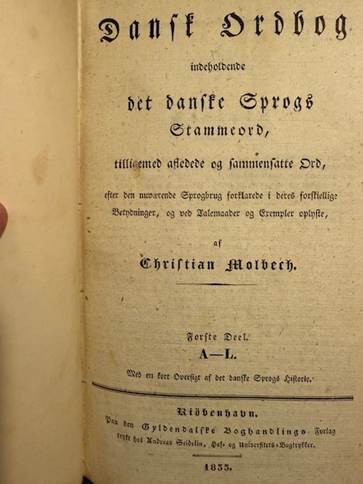
An option is also Christian Molbech: Dansk Ordbog, I-II, Den Gyldendalske Boghandels Forlag, Kiöbenhavn 1833. Internet: https://archive.org/details/danskordbogindeh01molbuoft/page/n5/mode/2up. (April 2nd, 2026)
Bible translations in Hans Christian Andersen’s time
Christianity was important for Hans Christian Andersen. Not only ideas but also sentence from The Bible he used. To identify them you need to use a translation like the one Hans Christian Andersen used. It is most likely that Hans Christian Andersen used BIBLIA, det er: den ganske Hellige Skrifts Böger, med Flid efterseete og rettede efter Grundtexten, saa og med mange Parallelsteder og udførlige Indholdsfortegnelser forsynede. 16. oplag. Det Kongelige Vaisenhuses Forlag, 1819. This edition was the domination Bible in Denmark at the time. The Old Testament in this edition has a fundament in the translation in the so-called King Christian VI Bible from 1740. Kaj Mogensen writes p.83 in his doctor Livet – det dejligste eventyr. H. C. Andersens teologi, Vol. I-II, Existensen, København, 2017: “H. C. Andersen må for Det gamle Testamentes vedkommende have brugt Chr. VII’s (fejl: for Chr. VI’s) oversættelse fra 1740. Der kom en autoriseret oversættelse i 1819, men kun af Det nye Testamente” (In English: ” For the Old Testament, Hans Christian Andersen must have used Chr. VII's (error: for Chr. VI's) translation from 1740. An authorized translation appeared in 1819, but only of the New Testament.”)
Other translations used in Hans Christian Andersen’s time were:
1871 Det Danske Bibelselskab Revision af biskop Hans Svanes 1647 Revision af biskop Hans Poulsen Resens Oversættelse af 1607.
1866 Biblen eller den Kristne Kirkes Hellige Skrift, oversat fra Grundtexten af Dr. Jac. Chr. Lindberg, Forlagsbureauet i Kjøbenhavn – Internet: http://lindbergbibelen.dk/ (April 3rd, 2026)
1847 Bibelen eller Den Hellige Skrift, oversat fra grundteksten af Teolog Christian A. H. Kalkar.
1828 Det Gamle Testaments poetiske og prophetiske Skrifter, efter Grundtexten paa ny oversatte og med Indholdsfortegnelse samt Anmærkninger forsynede af Dr. J. Møller og Dr. R. Møller. 1828-1830.
1819 Kong Frederik VI's Nye Testamente (New Testament): Vor Herres og Frelsers Jesu Christi Nye Testament, ved Kong Frederik den Siettes christelige Omsorg med Fliid efterseet, og rettet efter Grundtexten, saa og med mange Parallelsteder og udførlige Indholdsfortegnelser forsynet. Det Kongel. Viasenhuses Bogtrykkerie og paa dets Forlag, 1822.
https://www.dansksproghistorie.dk/95 (April 2nd, 2026) have all the translations from 1700-1900.
https://lex.dk/bibelovers%C3%A6ttelser has in Danish the history of Danish Bible translations. Lex.dk can – if you read Danish – help you with serious information.
Newspapers and other Periodicals
If you need articles from Danish newspapers, you can use this link:
https://www2.statsbiblioteket.dk/mediestream/avis (April 2nd, 2026)
Here is free access to 7.499.444 newspapers pages, and limited access to 27.912.528 newspapers pages.
Several media houses have made their digital newspapers available online, so that everyone can access them – either free of charge or for a fee. Nordjyske Medier has the largest archive with approximately 3.8 million North Jutland newspapers. We are also aware that these newspapers offer access to an online historical archive: Bornholms Tidende, Børsen, Der Nordschleswiger, Ekstra Bladet, Flensborg Avis, Fredericia Dagblad, Fyens Stiftstidende, Horsens Folkeblad, Information, Jyllands-Posten, Kristeligt Dagblad (PC’s with IP from Brazil is blocked), Lolland-Falsters Folketidende, Politiken, Skive Folkeblad and Århus Stiftstidende.
Periodica: https://www.Tidsskrift.dk (April 3rd, 2026)
Books in Portuguese
Only a few you can access in Portuguese at internet. In print:
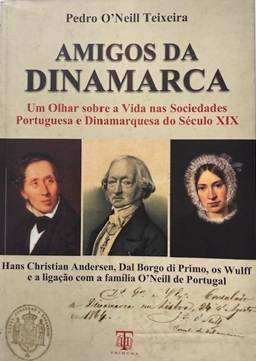
Pedro O’Neill Teixeira: Amigos da Dinamarca…Hans Christian Andersen, Dal Borgo di Primo, os Wulff e a Ligação com a família O’Neill de Portugal, copyright 2005, Tribuna, printed in Lisboa, 2006. 447 pp. + 32 pl.
Andersen’s book after visited Portugal, in 1866
Hans Christian Andersen visited Portugal in 1866. We visited the family O’Neill. This was a very old relation from his youth in Copenhagen. You can follow his visit in Portugal in the diary (at internet se: 1.1.2.), but he also gave out a book about the trip. This was his last travel book. Andersen gave it out in Samlede Skrifter, Vol. 28, C. A. Reitzels Forlag, Kjøbenhavn, 1868, pp. 117. In the 2nd Edition it is in vol.8, pp. 483-556, C. A. Reitzels Forlag, Kjøbenhavn, 1878. Internet: See 1.1.1. Colleted Works – Samlede Skrifter.
Two translations are both in more editions. They are not difficult to access in print:
Uma visita em Portugal, 1866. Tradução do Dinamarquês, Prefácio e Notas de Silva Duarte, 4 ed. Gailivro, Caneles, 2003. 144 pp. Ill. (1st ed. 1971, 2 ed. 1984. Instituto de Cultura e Lingua Portuguesa, Lisboa)
Hans Christian Andersen em Portugal. Edição particular de Niels Fischer no bicentenário de Hans Christian Andersen 1805-2005, Lisboa, 2005. 131 pp. Ill.
Stories and Fairy Tales
Histórias e Contos de Fadas. Obra Completa I-II, Tradução Eugenio Amado, Villa, Rica, Belo Horizonte 1996 – 80+76=156 Histories and Fairy Tales. The total number is normally 212¨or 213. This translation is without “Livros de gravuras sem gravuras” (34) and Fairy Tales as a part of other books.
Contos de Andersen. Traduc,ão do dinamarquês por Guttorm Hanssen. Revisão Herberto Sales. Paz e Terra, Rio de Janeiro, 1978. (6a Ediac,ão1988, 7a Edic,ão 2002)
Contos de Hans Christian Andersen. Traduzidos do dinamarquês. TRaduc,ão: Silva Duarte. Prefácio Novaes Coelho, Paulinas, São Paulo, 2010. 782 pp. (1a edic,ão 2011; 2e reimpressão 2013)
Pequenas Pinturas Poucas Palavras, Hans Christian Andersen Instituttet, Tradução Ana Maria and Niels Jørgen Martins da Costa Santos Langkilde, ISBN: 978-65-00-04357-0
A substantial number of books for children – often with short forms and modernization of the text. Most of them include illustrations. Some of the illustrators are used in mange translations to countries all over the world.
Bibliography
The main bibliography for Portuguese language is:
Sv. Juel Møller: Bidrag til H. C. Andersens Bibliografi, Vol. VII: Værker af H. C. Andersen oversat til portugisisk. Det kongelige Bibliotek, København 1975. 93 pp. – With a Portuguese title too.
To this you can add: Bibliografia de H. C. Andersen – 1805-1875. Em colaboracão com a Embaixada da Dinamarca – Biblioteca National. Lisboa, 1984.
Hans Christian Andersen 1805-1875. Mostra bibliográfica, 3 de Março – 14 de Maio de 2005. Biblioteca Nacional, Lisboa 2005, 102 pp., 8 pl.
Louro, Susana V.: Med H. C. Andersen i Portugal i år 1866. Fotoudstilling fra Portugal’s Turistbureau. Forlaget Afveje, Ørbæk 2004. 28 pp. 1st ed. 1976 24 pp. (From an exhibition organized by The Portuguese Turist Agency)
Hans Christian Andersen paper cutting, picture books and photos of him
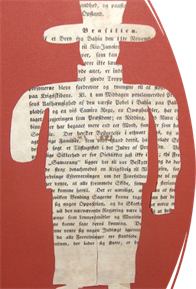
https://www.hcandersen-homepage.dk/?page_id=1038 (April 3rd, 2026) has a great number of his papercuts. Through the link you can find a great deal of them. This homepage is temporary not updated so much because the owner is in a not so good health.
https://samlinger.museumodense.dk/HCA (April 2nd, 2026) gives access to the paper cuttings in Museum Odense.
In https://www.samlinger.museumodense.dk you could find the list of his sixteen picture books to children among the families Hans Christian Andersen was connected to. These books are very costly and unique. Internet: https://samlinger.museumodense.dk/HCA/Billedb%C3%B8ger (April 2nd, 2026)
The special status is held by these Hans Christian Andersen's picture books. He created by them by cutting out from newspapers, magazines and books and putting the clippings together with a Fairy Tale text. A few have been published, and the originals are great treasures. A total of sixteen such books are known, but more may emerge in the coming years. Kjeld Heltoft has described them in detail in "Klippebøger med collager“ in: Hans Christian Andersen as an Artist, Gylling, Christian Ejlers´ Forlag, 2005. Hans Christian Andersen himself described the creative process in the Fairy Tale Gudfaders Billedbog (In English: Godfather’s Picture Book in internet: https://andersen.sdu.dk/vaerk/hersholt/GodfathersPictureBook.html) from 1868.
In books you find much more here:
Johan de Mylius: H. C. Andersen Papirklip Papercuts, 2. print, Sangill Grafisk Produktion, Aschehoug Dansk Forlag A/S, 2000,
Bjørn Ochsner: Fotografier af H. C. Andersen, Odense, 1957. 92 pp.,
Henrik G. Poulsen: Det rette Udseende. Fotografernes H. C. Andersen, Aalborg 1996. 175 pp., and
Tove THAGE: Fotografernes H. C. Andersen. En ikonografi, 1st ed., 1. print, Gylling, Høst og Søn, 2007.
Hans Christian Andersen’s manuscripts
Hans Christian Andersen kept lots of his manuscripts. Some were given as gifts, some kept the editors, but most of the manuscripts were bequeathed to the main heir, Edvard Collin.
The biggest collections are at The Royal Library in Copenhagen (in Danish: Det Kongelige Bibliotek/KB) and in Odense at the Museum, now called: Museum Odense.
Manuskripeter.hcax.dk showed the manuscripts. The hompage have changed, so no access now goes though: https://samlinger.museumodense.dk/hca (April 2nd, 2026). Later in the seminar you will have an introduction to them and the work with the manuscripts. I need to mention Ane Grum-Schwensens Ph.d.: Fra strøtanke til værk – En genetisk undersøgelse af de kreative processer i den sene del af H. C. Andersens forfatterskab, Vol. I-II, pp. 218+112, with an English resume. Institut for Kulturvidenskaber, Syddansk Universitet, 2014. (English title: From stray thought to work. A genetic study of the process in the latter part of Hans Christian Andersen’s authorship)
In print: The most important is Lauritz Nielsen: Katalog over Danske og Norske Digteres Originalmanuskripter i Det Kongelige Bibliotek I-III, København 1941-43. Vol. I pp. 10-26 is Hans Christian Andersen. Internet: Page 10: https://permalink.kb.dk/permalink/2006/manus/725/dan/10/ (April 2nd, 2026). And last page, p.26: https://permalink.kb.dk/permalink/2006/manus/725/dan/26/ (April 2nd, 2026).
Author:
Niels Jørgen M. da C. S. Langkilde
Illustration:
Niels Jørgen Langkilde
Fonte:
--
Contributions:
Niels Jørgen Langkilde